Particles#
An entity represents an emitter. The GPU owns individual particles, so game code controls an effect and its emitter rather than inspecting particles one at a time. The particle API carries the original effect recipe, schedule, spawn shapes, curves, gradients, playback and pool guidance.
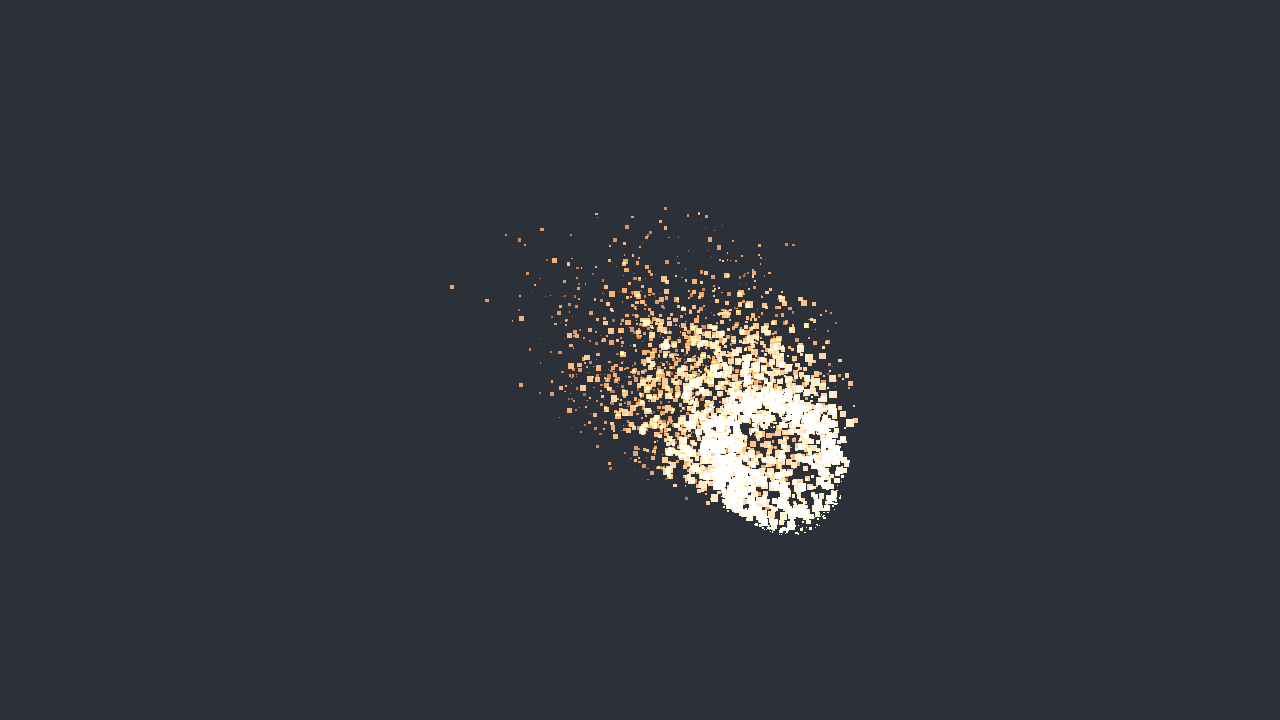
nupp task ex-particlesSpace pauses the field, B adds a burst, R restarts with the same seed and C clears existing particles. The emitter moves while world-space particles stay where they were born.
Each emitter reserves its effect's capacity from the world pool. A pool supports up to 4,000,000 particles. Capacity is GPU storage, not four million ECS entities or CPU tables. The host receives one short record per emitter and dispatches the original emit, spawn and simulate algorithms. Paused fields retain their GPU state; removing an emitter lets its live particles drain before releasing its range. Removing the last field releases the native pool.
Snapshots store effect names and emitter playback. Register those effects before loading a snapshot. Individual GPU particles are not saved: a restored field starts empty and refills from the saved schedule.
Alpha and additive particles draw as emitter groups in pool-slot order. They are depth-tested against opaque geometry, but particles within one effect are not individually depth-sorted. Use layers to separate effects that need a particular depth relationship. Particles do not cast 2D shadows.